
Reynald Joseph’s Troubadour, 2001 ca: A Village Song Beneath the Trees
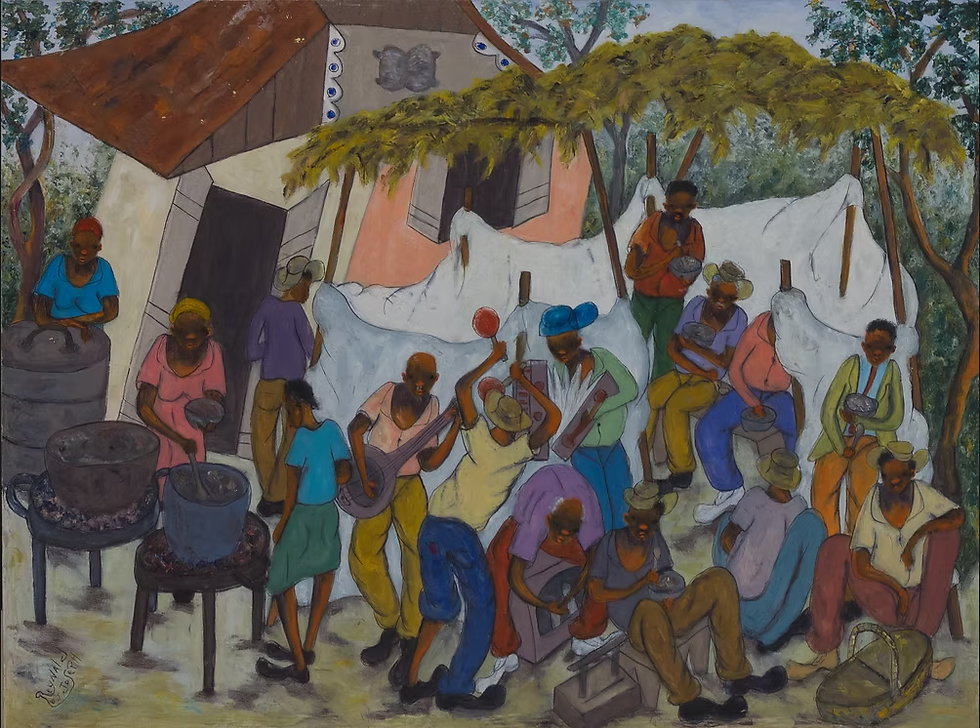
Imagine a Haitian afternoon where music rises like warm air from the earth, where neighbors gather not for spectacle, but for rhythm, labor, laughter, and shared memory. In Troubadour, 2001 ca, Reynald Joseph invites us into a living village scene—one filled with sound, movement, and the quiet poetry of daily life. The painting feels both festive and intimate, as if we have stepped into a moment already in progress, where every figure has a role in the music of the community.
The Courtyard Where Music Becomes Memory
At the heart of the painting, a gathering unfolds beneath a canopy of green leaves and pale sky. White cloths or sheets stretch across the background like soft walls, creating a stage of everyday life. Behind them, simple houses with warm roofs and muted pastel walls anchor the scene in a familiar Haitian village setting.
The people are arranged in a gentle rhythm across the canvas. Some sit, some stand, some cook, some play instruments, and others seem to listen with their whole bodies. A guitarist leans into his music, his instrument angled across his chest as if it were speaking through him. Nearby, another figure holds a small stringed instrument, while others beat drums or metal pans, adding pulse and texture to the gathering.
On the left, large cooking pots sit over open flames, their dark forms heavy and grounded. They suggest food, preparation, hospitality, and the deep connection between music and communal nourishment. Smoke, heat, and rhythm seem to mingle in the same air.
Joseph’s colors are earthy yet alive: rust-red roofs, turquoise shirts, lavender and rose garments, yellow trousers, green foliage, and soft white fabric. The figures are outlined with a direct, expressive simplicity, giving the scene a folk-like honesty. Nothing feels overly polished; instead, everything feels remembered, loved, and lived.
The painting’s emotional center is not one single person, but the collective energy of the group. The “troubadour” is not merely the musician—it is the spirit of song moving through the village. Music becomes a shared language. The seated figures, the cooks, the players, the listeners, and even the quiet houses seem to participate.
There is also a spiritual stillness beneath the activity. The white sheets in the background feel almost ceremonial, like a veil between the ordinary world and the ancestral one. The trees bend protectively above the people, and the courtyard becomes a sacred social space where memory, culture, and sound are preserved.
Share Your Vision
What did you visualize as you imagined this scene?
Did you hear guitar strings, drumbeats, voices, or the sound of cooking pots over fire?
Which figure stood out to you most—the musician, the cook, the seated listener, or someone quietly absorbed in the moment?
Did it remind you of a village story, a family gathering, a festival, or a dream of music carried through warm evening air?
Share your own interpretation in the comments and tell us what Troubadour brought to your imagination.
Now… See for Yourself
Was your imagination close to the canvas?
Or explore more about the artist:
This is just one of the many visual treasures at Haiti Collection Privée. Explore the gallery and experience the depth, rhythm, and spirit of Haitian art.


Comments