
The Soul of Haiti: A Living Art Tradition
Updated: May 15

From the sacred murals of Port-au-Prince to galleries around the world, Haitian art is one of the Western Hemisphere's most vital and deeply human creative traditions.
An Art Like No Other
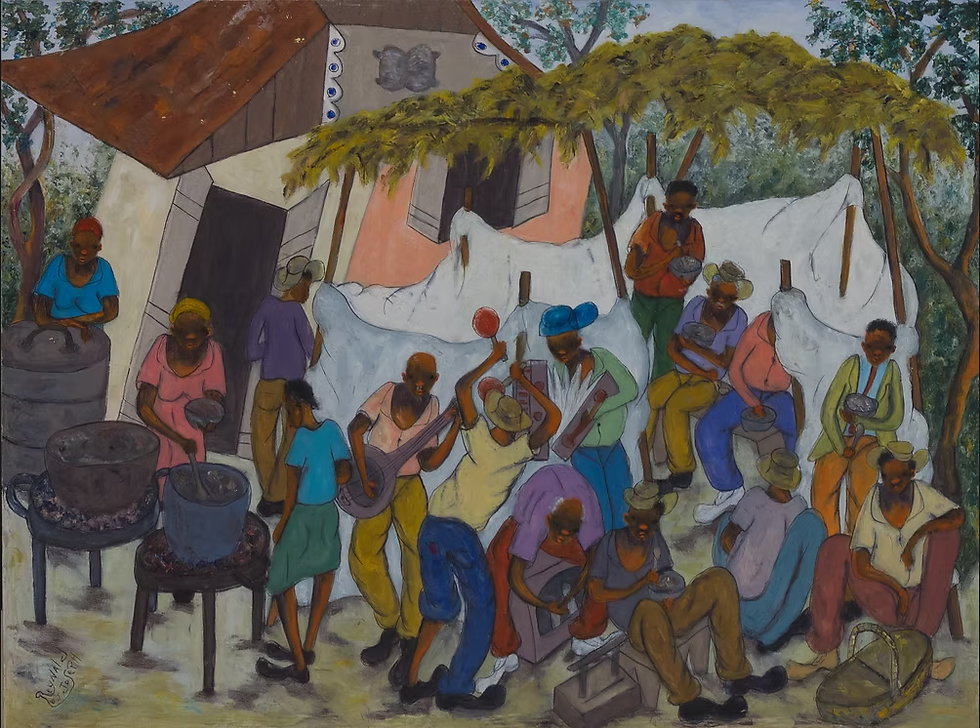
There is a painting that can stop you cold. It might be a scene of Caribbean life so vivid you can almost hear the market vendors calling out their prices, or a vision of Vodou ceremony so charged with spiritual energy that the canvas itself seems to pulse. This is the power of Haitian art — and it has been captivating the world since the mid-twentieth century, when a handful of self-taught painters in Port-au-Prince astonished international collectors and museum curators with a style entirely their own.
Haiti's artistic tradition is not an imitation of European movements nor a simple folk craft. It is a fully realized visual language born from the island's singular history — the only nation in the world forged by a successful slave revolution — and nourished by the rich spiritual life, natural beauty, and communal memory of its people. To collect Haitian art is to hold something irreplaceable: a window into one of the most extraordinary human experiences on earth.
The Birth of a Movement
The story of modern Haitian painting begins in 1944, when American watercolorist DeWitt Peters opened the Centre d'Art in Port-au-Prince. Peters had come to Haiti to teach, but what he discovered was a community of visionary self-taught artists who needed nothing more than materials and an audience. Within months of opening its doors, the Centre had become a crucible of creativity that would send shockwaves through the art world.
The artists who emerged from that milieu — Hector Hyppolite, Castera Bazile, Wilson Bigaud, Philomé Obin — were not painting in imitation of anyone. Their work drew on Haitian Vodou iconography, biblical imagery, Caribbean landscapes, and the lived experience of daily life in ways that were wholly original. When the Bishop of Haiti invited several Centre d'Art painters to create murals for the Episcopal Cathedral of Sainte-Trinité in 1951, the result was one of the landmark achievements of twentieth-century religious art.
Key Moments in Haitian Art History
1944 — DeWitt Peters founds the Centre d'Art in Port-au-Prince, launching the modern Haitian art movement and bringing its artists to international attention for the first time.
1950 — Wilson Bigaud wins second prize at an international exhibition in Washington, D.C. — the first major international honor for a painter from the Centre's generation.
1951 — Castera Bazile, Wilson Bigaud, and fellow artists complete landmark murals in the Episcopal Cathedral of Sainte-Trinité, later acclaimed as a masterpiece of Caribbean sacred art.
1955 — Castera Bazile wins the grand prize at the Caribbean International Art Competition, followed in 1957 by a prestigious award from Holiday Magazine.
2022–2023 — Frantz Zephirin is included in the Venice Biennale's "Milk of Dreams" and presents "Cosmic Mirrors" at NSU Art Museum Fort Lauderdale — proof that the tradition remains vital and globally celebrated.
Themes That Define the Tradition
What makes Haitian painting immediately recognizable — and endlessly compelling — is the way it weaves together several distinct threads of meaning into compositions of extraordinary richness.
Vodou & Spiritual Life
The _Lwa_ — spirits central to Haitian Vodou — inhabit countless canvases: Erzulie, Ogou, Baron Samedi, rendered with reverence and symbolic precision. Spiritual imagery is never mere decoration; it is theology in paint.
Caribbean Nature
Dense tropical foliage, turquoise coastal waters, lush market gardens, and the animals of the Haitian countryside appear in paintings that celebrate the island's natural abundance with almost ecological intensity.
History & Liberation
Haiti's 1804 Revolution — the only successful slave rebellion in history — casts a long shadow over the visual imagination. Scenes of resistance, freedom, and national identity run through the tradition from its earliest days.
Biblical Narrative
The Sainte-Trinité murals established a tradition of Haitian retellings of scripture — the Nativity, the Last Supper, the Baptism of Christ — in which the participants are unmistakably Haitian, and the landscape unmistakably Caribbean.
Haitian art does not ask you to observe from a distance. It pulls you inside — into the ceremony, the market, the forest, the myth — and holds you there until you feel, even briefly, what it is to inhabit that world.
Artists You Need to Know
The breadth of talent represented in the Haitian canon is astonishing — from the pioneering first generation who built the movement from nothing, to contemporary artists whose work is now shown at the Venice Biennale. Here are five figures whose work is essential to understanding what Haitian art is and what it can be.
Wilson Bigaud (1931–2010)
Discovered as a teenager by DeWitt Peters and mentored by the legendary Hector Hyppolite, Bigaud went on to paint some of the finest panels in the Sainte-Trinité Cathedral murals. His Marriage at Cana remains one of the masterworks of twentieth-century Caribbean sacred painting. His work is held in permanent collections at the Museum of Modern Art in New York, the Milwaukee Museum of Art, and the UCLA Fowler Museum, among others.
Castera Bazile (1923–1966)
One of the five painters chosen to create the historic Sainte-Trinité murals, Bazile contributed three panels — The Ascension of Christ, The Baptism of Christ, and Christ Expelling the Money Changers — that remain touchstones of Haitian religious art. He also won the grand prize at the Caribbean International Art Competition in 1955 and a prestigious Holiday Magazine award in 1957.
Frantz Zephirin (Born 1968)
Born in Cap Haïtien and influenced by his uncle Antoine Obin, Zephirin is the most internationally recognized living Haitian painter. His densely symbolic canvases of Vodou cosmology have earned him a Gold Medal at the Third Biennal of Caribbean and Central American Painting, inclusion in the 2022 Venice Biennale, and a solo exhibition at NSU Art Museum Fort Lauderdale in 2023.
André Pierre (1914–2005)
A Vodou priest and painter in equal measure, André Pierre created some of the most spiritually authoritative images of the Lwa ever committed to canvas. His work carries the weight of lived religious practice — these are not illustrations of ceremony but acts of devotion in paint.
Louisianne Saint-Fleurant (1923–2004)
A rare female voice in the first generation of Haitian modernism, Saint-Fleurant painted landscapes and village scenes of striking luminosity and lyrical beauty. Her work offers a gentler, deeply observant vision of Haitian life — one that rewards unhurried looking.
Why Haitian Art Matters Now
Haitian art has been undervalued relative to its historical significance for too long. Works by first-generation masters are held in permanent collections at institutions like MoMA, the Milwaukee Museum of Art, and the Waterloo Museum of Art — yet the market for these artists remains accessible to collectors who act thoughtfully and early.
Beyond investment, there is the simpler question of what it means to live with one of these paintings. Haitian art is not background decoration. It is active, alive, and full of narrative. A canvas by Castera Bazile or Frantz Zephirin will reward years of looking — there is always something more to discover, always another layer of meaning or beauty you hadn't noticed before.
The tradition also matters because it is fragile. Haiti's ongoing political and economic difficulties have made it harder for young artists to develop their craft, and some older works are already lost. Collecting with care — understanding what you are acquiring, where it comes from, who made it — is also an act of cultural preservation.
A Tradition Worth Knowing
There is a word in Haitian Creole — lakou — that refers to the communal yard shared by an extended family, the center of Haitian social and spiritual life. In many ways, Haitian art is itself a kind of lakou: a shared space where individual voices gather, where history is remembered and ceremony is enacted, where beauty is not a luxury but a necessity.
At Haiti Collection Privée, our mission is to bring that space to collectors around the world — to make it possible for anyone, anywhere, to live with one of these extraordinary paintings and feel themselves, however briefly, connected to something larger than themselves.
We invite you to explore our collection, read the artist biographies, and reach out with any questions. We are here to help you find the painting that will change the way you see.


Comments